1st Edition Research Dr. David Chavez

 Rhoades to Reading 1st Edition Research Dr. David Chavez

A Statistical Analysis of the Effectiveness of the Reading Intervention Project at Sequoia Middle

School

David V. Chavez

California State University, San Bernardino

Suzanne L. Reid

Loma Linda University

Muriel Lopez

Claremont Graduate School

Presented to Jackie Rhoades & Dr. Maria Palacio

Sequoia Middle School

Fontana Unified School District

April 16, 1999

The purpose of this analysis is to statistically support the effectiveness of the reading program currently in place at Sequoia Middle School in the Fontana Unified School District using reading scores previously collected in 1997 & 1998. It is hypothesized that those students who participated in the reading intervention program would show greater growth between 1997 & 1998 than those students that did not participate. Towards this end, two hundred and thirty-one children who participated in the intervention and had both 1997 & 1998 reading scores (intervention group) were compared to one hundred and four children who did not participate and had both 1997 & 1998 reading scores (non-intervention group). Children were selected to participate in the intervention based on an initial assessment of reading ability with poorer readers entered into the intervention group. The mean score for the children in the intervention group on the 1997 reading test was 4.197. The mean score for the children in the non-intervention group on the 1997 reading test was 4.483. A t-test revealed that this difference approached significance

(t=-1.97, p=.065). While not significant, the difference in initial mean scores strongly recommended a second analysis that will be described later. A second t-test was run for the grade equivalent growth of each group. This t- test revealed that the mean gain of .977 years for the intervention group was significantly greater than the mean gain of .507 years for the nonintervention group (t=3.49, d1--207, p=.001; see figure 1). Interestingly, a third t-test revealed that the 1998 grade equivalent mean reading scores of 4.894 for the intervention group and 4.989 for the non-intervention group were not significantly different from each other.

Taken as a set, these analyses suggest that the two groups tested at relatively different levels in 1997, with those children placed into the intervention scoring below those that were not placed into the program. Test scores for 1998 revealed that children in the reading intervention

group gained almost a full grade in their abilities, while those that did not participate gained about a half a grade. This difference in growth is a meaningful one as exhibited by the fact that both groups' reading scores are comparable in 1998.

As mentioned earlier, the groups were not equal in their pre-test reading scores. This difference can be perceived as a limitation of the previous analysis. It can be argued that a group that begins at a lower level stands to gain more ground in the following year. While this argument belies the reality seen in education that low achieving children fall further and further behind each year rather than naturalistically "catching up", it is a legitimate research critique. Therefore, a second analysis of selected cases was conducted.

In this second analysis, we selected out cases from the larger group - the intervention group - so that the remaining group would be comparable to the non-intervention group. In order to do this, the distribution of scores for the non-intervention group served as a model for case selection from the intervention group. Interestingly, the range of scores for both groups was remarkably similar (1.5 - 7.9 for the intervention group and 1.5 - 9.9 for the non-intervention group). It was the frequency distribution that was different with greater number of lower cases in the intervention group. This is consistent with the initial selection process for inclusion in the intervention group. Cases were randomly selected using a random numbers table for deletion in those instances where there existed a larger number of cases in the intervention group (primarily in the lower range). A single case was also left at each score level in the intervention group when there was no representation in the non-intervention group in order to maintain some degree of semblance to the original sample. In addition a single case was deleted from the non-intervention group because the reading score of 9.9 had no comparable matched case in the intervention group. This left a sample of 111 students in the intervention group with a range of scores

between 1.5 and 7.9 and a sample of 103 in the non-intervention group with a range of scores between 1.5 and 8.1.

Once case selection was done to create matched samples, the same series oft-tests were conducted. The mean score for the remaining 111 children in the intervention group on the 1997 reading test was 4.475. The mean score for the remaining 103 children in the non-intervention group on the 1997 reading test was 4.430. A t-test revealed that this difference did not approach significance. This suggests that the groups were now comparable and that results from this

second analysis would not have the same sample limitations as in the previous analysis. A second t-test was run for the grade equivalent growth of each group. This t- test revealed that the mean gain of .934 years for the intervention group was significantly greater than the mean gain of .554

years for the non-intervention group (t=2.15, df=212, p=.033). Interestingly, a third t-test revealed that the grade equivalent mean scores of the intervention group (5.409) now

significantly exceeded that of the non-intervention group (4.984) (t=2.13, df=212, p=.034; see figure 2).

Taken as a set, these analyses suggest that the random selection of cases was successful in creating a comparable subset of intervention group scores for analysis. Test scores for 1998 revealed that those children in the reading intervention group gained almost a full grade in their abilities, while those that were not in the intervention gained about a half a grade. This difference

in growth lead to the subset of comparable intervention children actually exceeding the reading abilities of the non-intervention children in 1998.

The analyses conducted suggest that the reading intervention is a successful one. Children are making meaningful gains that are helping them reach and exceed the reading level of children

who are not selected due to their higher initial reading scores. While this support is compelling,

future research might randomly assign comparable cases from the outset to the two groups to determine whether the same findings persist.


Rhoades to Reading 3rd Edition

  • Rhoades To Reading 3rd Edition coming soon
  • Designed for students in 3rd grade and above
  • Search 1st Edition for research and comments

One Step At A Time


What is Task Analysis?

Task analysis is a systematic analysis of content. Breaking a task into sequential parts leads to a set of clear instructions. The student can then move from point A to point B with a clear roadmap. The instructor has the flexibility of teaching each student, be they an adult or a kindergartner, in an age appropriate manner maximizing instructional time.

In the classroom- Task Analysis is an essential tool for designing lessons, and  Individual Learning Plans.

In the home- Task Analysis can be used to explain to children the basics of living. For example, telling a child to clean his or her room does not always achieve the desired results. Task analyzing the job with the child will not only build thinking skills but help
define a new definition of clean.

Not all students require a detailed sequence; however, if needed, the details are available and at the ready.The application of Task Analysis can be understood by stepping outside traditional academics to consider ways to teach a student to tie his or her shoes.

Examples of shoe tying directions developed by students in one of my college classes are listed below. We all agreed there is not one perfect way to conduct a task analysis and the task analysis varies with each student and group of students.

Student 1- Low Level of Complexity: The first student may simply observe others tie shoes, practice independently, and successfully tie his or her shoes.

Student 2- Medium Level of Complexity: The instructor may need to demonstrate and teach the skill as follows:
1. grab one lace in the left hand and the second in the right hand pull the laces straight up cross the shoelaces
2. pull the front lace around the back of the other pull that lace through the hole

3. tighten the lace with a pull make a bow
4. tighten the bow

Student 3- High Level of Complexity: This student may need a longer version such as the one that follows:
1. grab one lace in the left hand and the second in the right hand pull
2. pinch the end of one lace with the left hand and the other with the right hand

3. pull the laces up in the air
4. put one lace on the right side of the shoe, the second on the left side
5. pick up the lace on the left side with the left hand, pick up the lace on the right side with the right hand
6. pull the laces above the shoe 7. cross the laces to form a tepee
8. the student brings the left lace toward him/her
9. pull the left lace through the tepee pull the laces away from each other and so on….

Whether the task is simple or complex, knowing where you are going and how to get there makes life a lot easier

Stages of Reading Development

 Stages of Reading Development

The quality of reading is not measured by how soon a child begins to read but by how well he or she reads when ready.  


 Students learn in different ways and in synchronization with their own personal growth and development. 


 Reading acquisition  rates can differ from child to child within a single family.  For example,  one child may begin reading at age four while another does not begin reading until age six. Parents may be surprised to notice that both children are reading at the same level at age eight. w


With these thoughts in mind, following are the stages of reading development.


Birth to Kindergarten

Children learn to understand the spoken word, speak learned vocabulary, enjoy looking at picture books, having books read to them, and naming pictures  found in books. 


Kindergarten and Grade One

Students learn the names of the letters and the concepts of sound/symbol and symbol/sound relationships, linguistic patterns, the blending of sounds, and the recognition of certain sight words.


Grads Two and Three

Students expand decoding skills and deriving meaning from text as well as  increase reading fluency.


Grads Four Through Eight

Students learn information that goes beyond their life experiences. They apply expanded vocabulary to interpret and analyze points of view in a variety of contexts.


Grads Nine Through Twelve

Students develop complex language structures, interpret multiple points of view, learn advanced vocabulary and construct their own meanings through analysis and synthsis.


Additional Resources

Please click the redirect page below the title.

Notes From Parents, Teachers, and Administrators

Compliments

Following are a few of the compliments received from parents, tutors, and teachers. 


6th Grade Teacher:

This is a subtle, yet fast-paced program which encourages students to practice spelling and vocabulary while having fun. Always interesting, always attainable, the program teaches itself with the teacher's manual and student worksheets.

Special Day Class Teacher:
Rhoades to Reading is a sensible, easy to teach, reading program with lessons already planned. Best of all, students learn to read.

Grandmother:
On his entry to middle school my grandson was reading on a 2nd grade level. After receiving around 30 one-to-one sessions he is now reading at grade level. He scores well on the State test in reading and is gaining in the confidence I had always hoped for.

Mother:
Because of the help received using Rhoades to Reading, my daughter is now working at grade level, receiving excellent grades, and is spending less time on homework. Retention is no longer an issue. Best of all, my daughter does enjoy school.

Mother and Father
To whom it may concern: Since beginning Rhoades to Reading our son has had so much improvement in his reading skills. He was struggling with reading and so far behind his peers. After just a few weeks using Rhoades to Reading he went up eight reading levels, a surprise to his teacher and parents.

Mother:
I just wanted to let you know that I received my daughter’s progress reports today and I was VERY happy. My daughter so far is getting straight A's. Her confidence in school has improved and she no longer worries herself to sleep at night (about not completing her work).

Supervisor of Teacher Education:
I am particularly impressed with the fact that the Rhoades to Reading program can be used successfully by any number of students at any level of learning. The students in these classes are extremely motivated; they personally see their level of performance and proficiency rising and are obviously enjoying their successful learning experience.

They Didn't Give Up: Middle School Success!

Excerpt from Rhoades to Reading: A Successful Middle School Reading Program
By Tonianne Merante
California Middle School News Vol.20 No4

I’m happy to have this class.
Thank you for helping me this year.
I feel great about myself. I’m very happy.
Now that I have been in this class, I have been doing my homework.
I feel great that I got into this class because I’m doing better in my other classes.
Reading/writing success is the class that I like most
Now I can read and write better and don’t have to ask what the words are.

These comments and more were made by students enrolled in the reading/writing success classes that are part of the Rhoades to Reading program.

The classes were formed several years ago in an attempt to help the more that 60 percent of students who were seriously deficient in reading ability, performing two or more years below grade level. These students were not achieving academic success in their content area classes.

A schedule was implemented which allowed time for reading instruction, but we lacked a program which would raise students’ reading levels and be user-friendly for teachers with little knowledge of teaching reading.

The need was answered when the Rhoades to Reading program was …implemented. The program was used with up to 35 students in a class. The positive results were significant.

Note from Jacquie: Thank you to Mrs. Merante and the teachers, staff, and students who worked together to achieve success.


Research by Steven Brannon MBA


Statistical Analysis of Rhoades to Reading

By Steven Brannon MBA

Introduction This presentation presents results from a number of examinations covering students’ verbal skills. On each examination, a student would take a pre test and at a later point time a post test covering the same information, although using what is called a “parallel form” of the test. Using the same test for pre and post testing would bias results because of what are called “Memory Effects” or, simply stated, students would remember large amounts of information from the previous test. The fact that they would have time to discuss the pre test afterwards would further bias results. That error was not made in this study. Presenting Numeric Information Many find the science of statistics intimidating and horrifying. This is understandable considering terms like multicollinearity, coefficients of skewness and kurtosis, autocorrelation and others tend to glaze the eyes. This presentation
will avoid use of intimidating terms and data are presented in terms of the students’ first test scores (Called Pretest hereafter), and last test score (Called Post Test hereafter). Note that each student has two scores from the pre test and post test. It would bias the study to pair a pre test score from Susie Smith with a post test score from Kevin Simms. Performance is judged on the basis of mean scores. “Mean” is another name for “Average.” To compute one, add up scores and divide by the number of scores. One problem area is how to determine what is called “Statistical Significance.” This is an arbitrary construct although on an intuitive basis easily understood. If a teacher’s salary is increased by ten cents per day, she would be earning more although hardly impressed. For this presentation’s purposes, it will use the word “Significant” interchangeable with “Huge,” “Tremendous,” and “Exceptional.” Real-world examples would include a student improving from 500 to 700 on the SAT or a golfer whose average for 18 holes was usually 110 suddenly starting to consistently shoot in the high 60’s. Space considerations do not permit providing visuals so the presentation will focus on the mean and what is called the t statistic. The t test for paired scores (it is incorrect to simply say one used a t test) is used as parametric data (data with decimal places) are used at what is called the .05 level of significance. In other words researchers acknowledge that regardless of the size of the t value they admit possibilities of their information being incorrect 5% of the time. This is the industry standard. Pre vs Post Word Reading Gr. Equiv 2007-2008
t-Test: Paired Two Sample for Means


t Stat-2.49046
t Critical two-tail2.059537
The means of the two tests (pre vs post) are 4.403 (pre) and 5.557 (post). Although there seems to be some distance between the two means, the paired t test must be used to determine if the distance is “Significant” or not. Although the computation is not a difficult one, the formulas used are sufficiently appalling that most people avoid them religiously. Those curious may refer to any statistics test for Paired (Related) T Test. Although it will only be done for this set of scores, showing an Excel printout will help.
t Stat2.49046
t Critical two-tail2.059537

Reading the table is easily done. The t stat was derived from computations based upon the scores. The t critical is the dividing line between what is declared significant and not significant. In other words if the t critical is larger than the t stat, nothing significant happened or, in layman’s terms, there was not enough improvement noted to state that the treatment applied (a reading program, new text etc) worked any better than what had been done in the past. With all of that said, we can state that on this particular test that students improved tremendously as the computed t stat of 2.49 is greater than the critical value of 2.059. We end the process with a plain English statement that students in this study improved substantially. From our information, luck was not a factor. Pre vs Post Sentence Comp Gr. Equiv 2007-2008 Students were administered this test under the same conditions of the others. We are dealing with paired scores as two scores were obtained from the same student at different points in time using parallel form tests defined earlier. Students’ performances improved significantly (tremendously) as the computed t statistic of 2.957 exceeded the critical value of 2.055. Pre vs Post Spelling Gr. Equiv. 2007-2008 Comparing the t statistic of 5.668 with the t critical value of 1.996 indicates improvement that not only is significant but staggering bringing to mind a weekend golfer who suddenly qualifies for the PGA Tour and becomes a consistent money winner. Pre vs Post Word Reading Gr. Equiv 2006-2007 Given the computed t statistic of 8.31592 when compared to the t critical value of 1.9949, we must conclude students made tremendous gains well outside the realms of chance. Pre vs Post Sentence Comp Gr. Equiv 2006-2007 Given the computed t statistics of 6.88763 when compared to the t critical value of 1.994945, students made tremendous gains over this study gains which cannot be attributed to chance. Pre vs Post Spelling Gr. Equiv. 2006-2007 The computed t statistic of 8.315 when compared to a t critical value of 1.99 indicates improvement on a level which can only be considered staggering.

.

Alphabet Flash Cards Included

Teaching Letter Recognition - A Complete Lesson

,Appropriate for Whole Class,  Small Group,  and Individual Presentations
contains multisensory and cooperative learning activities

This lesson \  also contains worksheets, reading sheets, timed readings and flash cards.

Please note: To accommodate  a variety of learning challenges, the flash cards are written in black and white, without pictures, and key words.  The emphasis is  placed on memorzing the letter name rather than any visual distraction.  

Please click the link below to download the  lesson.

Letter Recognition

Student Project Video Included


Mix Process+ Content + Feeling to Create Success


Process Defines the Method of Teaching. 

When planning a lesson, the instructor has many processes, sometimes  referred to as structures or activities, from which to choose. Large and small group  instruction, computer assisted instruction, and cooperative learning are examples. Each strategy can work with almost  any curriculum.


  The challenge is matching the student or students to a process that is most effective. The following video, made quite a few years ago as a student project, provides examples of classroom activities that  integrate student success and peer engagement. The content is reading. However,  each activity may be used across the curriculum. The Thirteen Activities link that follows includes directions for implementing specific activities.


Student Project   redirect link


Thirteen Activities    redirect link


Content

Defines what is taught


Whether a classroom teacher, tutor, or parent, there is seldom  an opportunity to select content. However, the instructor often has a choice of delivery. Following is a mixed  list of approaches used by many instructors. Rreaders are welcome to add  favorite methods  in the comments scetion.

1. Link the subject to everyday life.  For example, when learning about ounces, weigh different objects, such as candy bars, to discover if the package information matches their findings. OR Ask a question such as: What would happen if the First Amendment of the Constitution  was erased?

2. Create a syllabus telling students the timeline for reading each chapter.

3. Design a rubric stating exactly what students are expected to learn.

4. Make a list of study questions  telling students what they are expected to learn.

5. If there are questions at the end of the chapter,  instruct students to read the questions before reading the chapter.

6. If vocabulary words are listed at the beginning or end of the chapter, review the meaning and use of the words before assigning indepent reading.

7.  Review and discuss chapter  headings with the class before assigning  independent reading.


• Feeling is  the Most Important Component of each Lesson. 


Many stress factors which inhibit learning are often out of a teacher's control. If a student is hungry, has not slept, worried about being "jumped" after class, is expected to read a sixth grade text when he or she can only read on a second grade level, are but a few examples.  For those who want to investigate stress and learning, please follow the link below.

Stress and Learning  indirect link

• 


Structure and content  are available tools  to assist in reducing stress. Feelings 
 are attached to every learning event and have a direct impact on the assimilation and retention of information.


• When learning is fun and tension free, information is  easily assimilated.


Mix Content, Process, and a positive feeling tone to creat teacher/student success.


 Aboout the Author

 Jacqueline Jo Rhoades


 Jacquie began her life in Chicago and moved to Pomona, California at an early age. After growing up in the country, surrounded by orange trees and truck gardens, she began her  career as a teacher, writer of curriculumr, and workshop presenter, in and out of the  United States. She now resides with her family  near her childhood home.   


 ,In addition to ,earning  a Master of Science degree in education from Mt Saint Mary’s College Los Angeles and a Bacelor of Science degree in sociology from Long Beach State University, Jacquie has received numerous awards from local and national leaders and organizations.

 Jacquie has taught general,  special education, and reading  in  elementary and secondary settings. Additional positions:  literacy leade, program specialist,  adjunct professor at Sonoma State University and Dominican College San Rafael. Additionally, she served as an  education specialist for the California Sepecial Education Resource Network.\

Teaching Tools Blog: www.readingcompany.us

Published Books: Simle Cooperation in the Classroom, The Nurturing Classroom, Social and Academic Activities for the Cooperative Classroom, Lessons from Cherry Creek, Outcome Based Learning: A teacher's Guide to Restructuring the Classroom, Rhoades to Reading levels A, B, C, D, Language Arts and Simple Cooperation

Curriculum is based on the theory and practice of the fClassroomllowing pioneers in education:  Madeline Hunter, David and Roger Johnson, Ana Gillingham, Maryanne Frostig, Reuven Feuerstein,  Ray Barsch, Donald Deschler, and Renee Herman.  While diverse,  each approach demonstrates students learn at different rates and in different ways; yet, when given a chance they  can learn.  

A special thank you to Jeannie and Ken Womack, Jenna Kreeger, and Tonianne Merante for editing the Rhoades to Reading program. My gratitude goes to Dr. Maria Palacio for permitting sixteen teachers to field test the curriculum , and to Dr. Linda Gamble for supporting our efforts. A number of lessons from Rhoades to Reading are posted on this blog.


Has cursive gone the way of quills and parchment?

From Psychology Today

Accprdomg to Ed Week  only 21 states require the teaching of cursive. EdWeek link 
While some say cursive belongs in the past, research says otherwise. 
The purpose of this article is to explore the reasons why cursive is an important element in learning and to provide one method for the teaching of cursive..

William R. Klemm Ph.D discusses.Cursive and Cognitive Development in Psychology today.  Following is a quote from this article.

Handwriting dynamically engages widespread areas of both cerebral hemispheres. Virginia Berninger, a researcher and professor of educational psychology at the University of Washington, says that brain scauring handwriting show activation of  massive regions of the brain involved in thinking, language, and working memory.


Writing Beats Typing discusses current research and explains in detail the reasons, though inconvienent, for teaching cursive. 


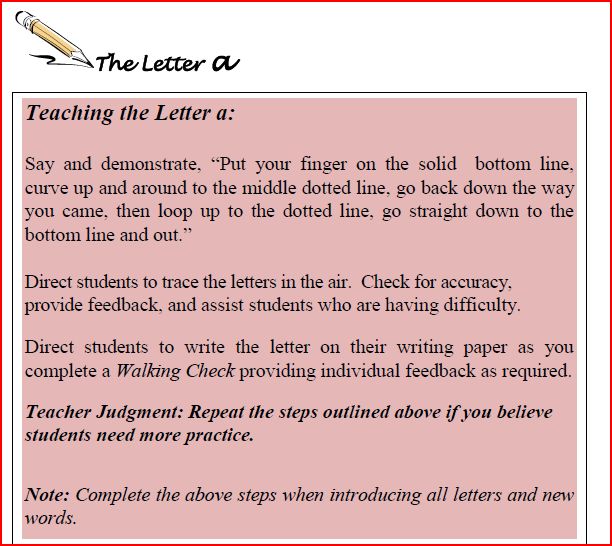
Whether working with one student or a class of 35, teaching cursive can be a multisensory activity rather than a chore. The following method for teaching cursive has been successful in  general  and special education classes.  The sample below demonstrates the method.  To access the  entire  lower case alphabet and sample writing paper, please follow the link below.

Teaching Cursive


Preparation

Draw two sets of solid, parallel lines about five feet long on the board
approximately 24 inches apart. Draw a dotted line midway between the
solid lines (approximately twelve (12) inches above the bottom lines).

Supply Students with lined writing paper..  Follow the air tracing process included in the Teaching Cursive lesson.


Note: Use this line formation for all letter and word demonstrations for as long
as required. When the students understand the concept of the dotted line
and can write correctly on their papers, the use of lined paper can be eliminated.